
GSA Strategy · July 2025
GSA Schedules vs. Open Market Bidding: Which Fits Your Business?
Two paths to federal contracts — a straightforward comparison to help you choose.
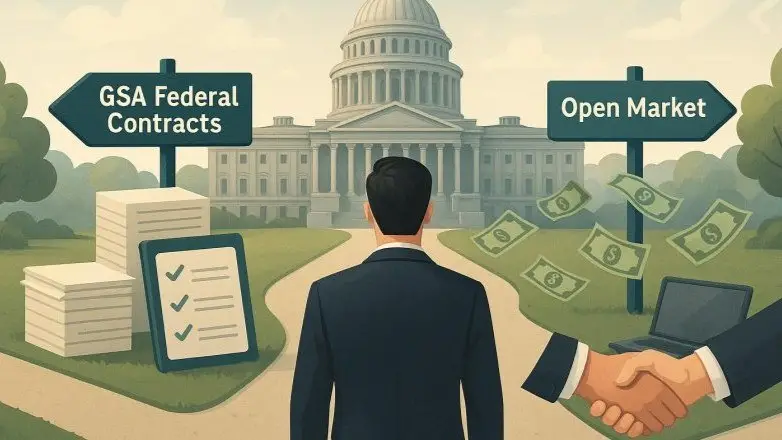
Did you know? In 2022, agencies spent $42 billion through GSA Schedules, up 22% from the year before. If you’re considering federal work, you’ve got two main paths: getting on a GSA Schedule or answering open-market bids. Both win contracts — here’s a straightforward look at each, with a few extra tips to boost your odds.
Quick Comparison
| Aspect | GSA Schedules | Open Market Bidding |
|---|---|---|
| Process Duration | < 30 days | 4–6 months |
| Competition | Limited to pre-approved vendors | Open to all qualified vendors |
| Pricing | Pre-negotiated rates | Custom pricing per project |
| Scope | Multi-agency use | Specific agency or project |
| Paperwork | Streamlined | Extensive |
GSA Schedules: Fast, Focused, and Flexible
What it is: A long-term contract that puts your “catalog” in front of government buyers.
Why it helps:
- Agencies can buy from you in weeks, not months.
- Being “GSA-approved” gives you instant credibility.
- Contracts last up to 20 years (with extensions).
Plus:
- Easy Repeat Buys: No new bidding each time; buyers keep using your contract.
- Smaller, Pre-Approved Pool: You compete only against other MAS holders.
- Access to GSA eBuy: RFQs are open only to MAS contractors.
- Build Past Performance: Work with multiple agencies under one contract.
- Marketing Edge: Your GSA Advantage! Profile is a built-in storefront.
- Sole-Source Awards: If you’re the only MAS holder for your service in a state, you may get direct awards.
GSA Schedule Advantages
GSA Schedules bring key benefits to government agencies and contractors alike:
| Advantage | Description | Impact |
|---|---|---|
| Streamlined Process | Pre-negotiated pricing and faster transactions (under 30 days) | Faster revenue opportunities |
| Market Access | Direct connection to government buyers | Expanded sales potential |
| Long-term Stability | 5-year contracts, extendable up to 20 years | Steady business development |
Open Market Bidding: Custom, But Lengthy
How it works:
- Agency posts an RFP on SAM.gov.
- You write a detailed proposal: price, approach, past work.
- They evaluate and pick a winner.
Good points:
- Tailor your solution and pricing to exactly what they’ve asked for.
- No up-front approvals or contract vehicles required.
- Opportunity to build direct relationships with agency decision-makers.
- You control the narrative, show off your innovation or niche expertise.
Watch outs:
- Often takes 4–6 months from RFP release to award notice.
- Extensive paperwork: compliance checklists, attachments, multiple revisions.
- Multiple reviewers can introduce unpredictable scoring.
- Larger pool of bidders; anyone qualified can throw their hat in.
- You’ll need solid past performance to compete against seasoned contractors.
Open Market Bid Process Steps
The federal open market process follows a clear structure:
| Step | Description | Timeline |
|---|---|---|
| Need Identification | Agency defines its needs and budget | 2–4 weeks |
| Solicitation Release | ITB/RFP posted on SAM.gov | 30–45 days |
| Bid Development | Vendors prepare and submit proposals | 15–30 days |
| Evaluation Period | Technical and cost proposals are reviewed | 30–60 days |
| Award Decision | Contract is awarded and signed | 15–30 days |
Which Path Fits You?
✓ Choose GSA Schedules if you want:
- A clear, step-by-step process and pre-approved status for buyers.
- Less paperwork and faster approvals for your small team.
- Fixed, up-front pricing so you know your budget.
- Repeat orders without having to bid again.
- A steady, predictable timeline for awards.
→ Choose Open Market Bidding (RFPs) if you want:
- To explain exactly what makes your service unique.
- Direct contact and relationship-building with agency staff.
- The chance to win one-off, high-value projects.
- The energy of competing each time you bid.
- Flexibility to propose custom solutions and pricing.
Next Steps
- Audit your services. Can you turn them into a rate-card “catalog”?
- Check your resources. 30-day MAS cycle or a 6-month RFP — what suits your team?
- Define your goal. Steady, multi-agency work or targeted one-off contracts?
Frequently Asked Questions
What is the main difference between GSA Schedule and open market bidding?
GSA Schedule (MAS) uses pre-negotiated rates and allows agencies to buy from you in under 30 days with limited competition among approved vendors. Open market bidding (RFPs) is open to all qualified vendors, takes 4–6 months, requires a full proposal, and allows custom pricing but involves a much larger pool of competitors.
How long does it take to get on a GSA Schedule?
The GSA MAS application process typically takes 3 to 6 months from submission to award. Once on contract, task orders can be placed in under 30 days, making it significantly faster than open market procurements for repeat buyers.
Can small businesses use both GSA Schedule and open market bidding?
Yes. Many small businesses pursue both paths simultaneously. GSA Schedule provides steady, repeat business with less paperwork, while open market RFPs offer opportunities to win high-value, one-off contracts. The right mix depends on your team size, bandwidth, and growth goals.