
GovCon Proposals · August 2025
Win the Contract Before They Even See Your Price
7 Fatal Flaws Reviewers Notice First — and how to fix them.
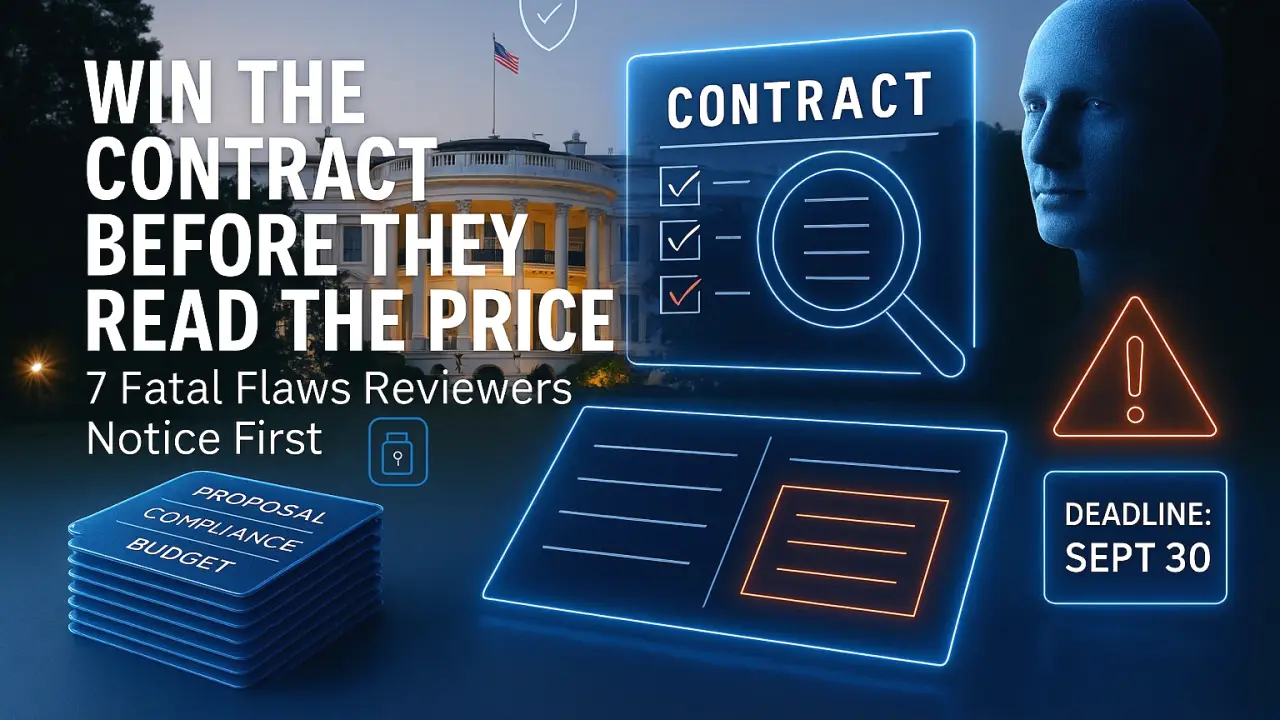
Winning a government contract starts long before pricing. It begins with a clear, compliant proposal that tells a convincing story. Agencies score offers on the factors and sub-factors listed in the solicitation, so your response must exactly match those conditions to be scored fairly.
Below is a practical, readable guide you can use today: the core proposal structure, what evaluators look for, then the seven fatal flaws that reviewers notice first, and how to fix them.
Key Proposal Sections (what to include and why)
1. Cover page & cover letter
Include the solicitation/RFP number, date, company name, and a contact. The cover letter should be short, signed, state your intent to respond, and highlight one or two strengths tied to the agency’s mission.
2. Table of contents
Use clear headings, page numbers, or hyperlinks so reviewers jump straight to required sections. Scannable documents make reviewers’ jobs easier.
3. Executive summary (one page)
Lead with value — restate the agency need, describe your solution in plain language, and list the top 2–3 benefits (cost, schedule, risk reduction). Keep it short and agency-focused.
4. Technical approach
The core of your response. Organize this section to mirror the RFP’s evaluation factors. Explain how you will meet each requirement: tasks, deliverables, tools, milestones, and risk mitigations. Use headings, bullets, and brief timelines.
5. Management & staffing plan
Show an org chart, name key personnel, list roles, and one-page resumes. Explain oversight, QA, communications, and subcontractor management so reviewers know you can execute on day one.
Past performance: Provide 2–3 closely related examples with client, contract value, dates, and measurable results. Agencies weigh relevance and recency heavily, so pick the best matches.
6. Cost/price proposal
Transparent and defensible labor categories, loaded rates, hours, ODCs, assumptions, and a price narrative that ties cost to the technical plan. Price realism is a frequent evaluation point.
7. Compliance & certifications
Include reps & certs, small business status, and any required compliance documents. A brief compliance matrix that maps each RFP requirement to where you address it speeds QA.
8. Appendices/attachments
Resumes, org charts, subcontractor letters, sample deliverables — label everything and reference it in the main text.
7 Fatal Flaws Reviewers Notice First, And How To Fix Them
Non-compliance (format, forms, deadlines)
Missing forms, wrong font, incorrect file names, or late submissions often stop a proposal before technical review. Fix: Build a Section L compliance checklist and run a full compliance walkthrough 48–72 hours before submission. Do a dry-run upload at least 24 hours early when possible.
Weak executive summary
A vague or long executive summary fails to hook the reviewer. Some evaluators read only the executive summary. Fix: Write the exec summary last. Lead with the agency problem and your top 2–3 measurable benefits in plain language.
Unfocused technical approach
If your technical section doesn’t mirror the RFP evaluation factors, reviewers struggle to score you. Fix: Match section headings to the RFP’s factors, use bullets and short tables, and explicitly state how each requirement will be met.
Weak or irrelevant past performance
Listing projects that don’t match scope or complexity undermines credibility. Fix: Use 2–3 close matches, include metrics (budget, schedule, outcomes), and give a client POC where allowed.
Opaque or unrealistic pricing
A bottom-line price without backup makes evaluators question price realism. Fix: Provide a detailed cost build-up and a price narrative. Show the hours × rates math and call out assumptions. Consider a price realism check against historical data or an independent estimate.
Sloppy writing & formatting
Typos, inconsistent fonts, and dense text look unprofessional and slow reviewers down. Fix: Use a consistent template, short paragraphs, bullets, and a final edit by someone who didn’t write the text. Fresh eyes catch what the team misses.
Rushing to submit
Last-minute uploads increase the risk of missing attachments or portal errors. Fix: Plan backward from the deadline, set internal milestones, and perform a final dry-run upload 24 hours early.
Quick Checklist You Can Use Now
- Match your section headings to the RFP evaluation criteria.
- One-page executive summary that leads with agency value.
- Map each RFP requirement to a section and page number (compliance matrix).
- Choose 2–3 highly relevant past performances and quantify outcomes.
- Price with a clear assumptions table and price narrative.
- Run a 48–72-hour compliance QA, then a 24-hour dry-run upload.