
Federal Contracting Trends · June 2026
Is Fixed-Price Contracting About to Become the New Normal?
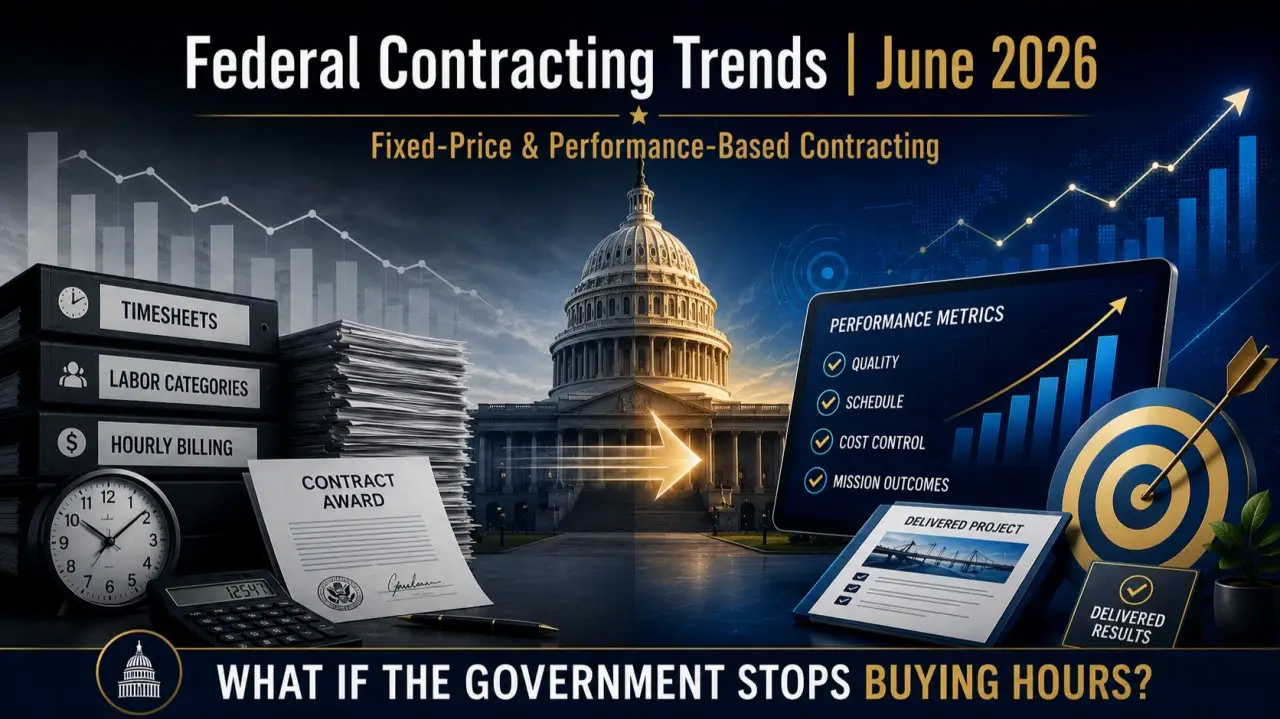
A recent federal contracting policy shift could signal a greater focus on outcomes, accountability, and contractor performance. Here's what GovCon teams should be watching.
I came across something recently that I think many GovCon leaders should be paying attention to.
In April, the White House issued an Executive Order directing agencies to maximize the use of fixed-price and performance-based contracts where appropriate.
At first glance, this may sound like another policy update. I don't think it is.
If this direction continues, it could influence how agencies evaluate risk, structure requirements, and think about contractor performance.
Outcome-Focused Proposals May Matter More
Many proposals still spend a lot of time talking about labor categories, staffing plans, and internal processes.
The question agencies may increasingly ask is:
As performance-based contracting gains attention, contractors may need to spend less time describing activities and more time demonstrating outcomes.
Can the evaluator quickly understand:
- What problem you're solving?
- What success looks like?
- How performance will be measured?
Risk Is Gradually Shifting to Contractors
One aspect that hasn't received enough attention is risk.
Under many fixed-price structures, the contractor assumes more responsibility for estimating effort, controlling costs, and delivering within agreed parameters.
In simple terms: if the work takes longer than expected, costs more than expected, or requires additional effort, the contractor may absorb much of that impact.
That's why strong pricing, accurate estimating, and disciplined project execution become increasingly important.
For some organizations, this could be a competitive advantage. For others, it may expose operational weaknesses that were easier to manage under different contract structures.
Past Performance Could Become More Valuable
Not just experience — results.
Can you demonstrate:
- Cost savings?
- Faster delivery?
- Improved mission outcomes?
- Reduced risk?
As agencies place greater emphasis on measurable performance, documented results may become one of the strongest differentiators available to contractors.
Pricing Discipline Becomes Critical
Under a fixed-price environment, estimation mistakes become your problem, not the government's.
Companies with mature delivery models, proven estimating processes, and strong financial controls may be better positioned to compete effectively while protecting margins.
What We Still Don't Know
One thing worth noting: the Executive Order is real. The long-term impact is still developing.
How agencies implement it, how contracting officers apply it, and how future solicitations evolve are all things we'll need to watch closely.
That's why I think it's important to separate confirmed policy changes from assumptions. The direction is clear. The pace and scale of implementation remain something the market will continue to learn over time.
What I'm Watching Next
My biggest takeaway? This feels less like a discussion about contract types and more like a discussion about accountability.
The contractors that can clearly define outcomes, control delivery risk, support pricing decisions, and demonstrate measurable results may be better positioned if this trend continues.
Are you already seeing agencies place greater emphasis on outcomes and performance metrics in the opportunities you're pursuing?